Ready for the toughest tracks

Optimising pipeline equipment performance by preparing for the toughest conditions

Pipeline construction rarely occurs under ideal conditions. Projects span deserts, mountains and remote regions, operating under intense pressure where a single mechanical failure can stall an entire operation. In these environments, there is zero margin for error.

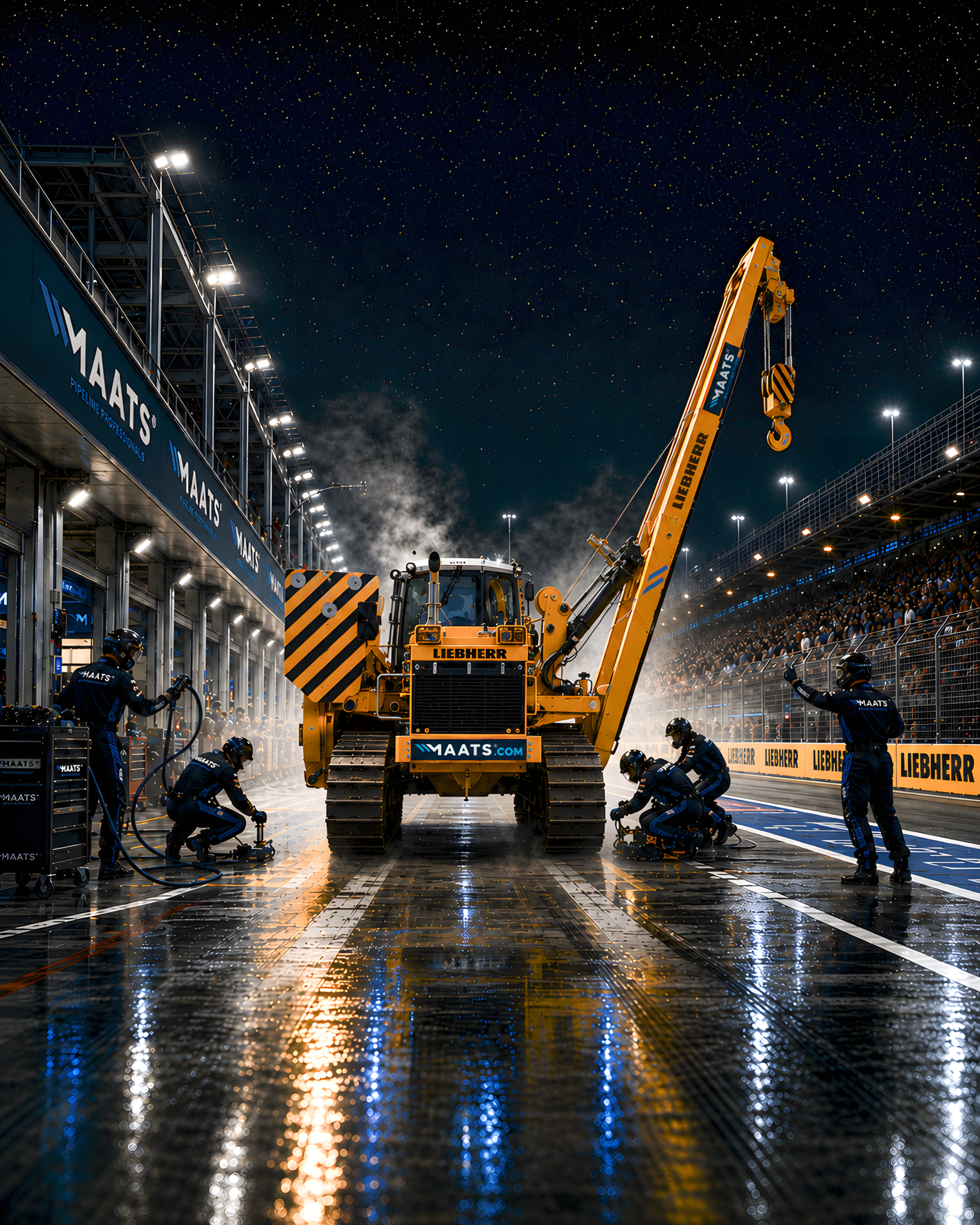
The same logic applies to racing. When pushing limits on a demanding track, any technical oversight leads to immediate downtime. In both worlds, every downtime carries a price. But the real difference is made before the race begins. Reliability is not proven on the track alone. It is built in the preparation leading up to it.

Where performance begins

At Maats Pipeline Professionals, we inspect, prepare and configure every machine within our specialised technical ‘pit lane’, before field deployment. Here, every unit is prepared, checked, and ready before it hits the track. Once equipment reaches the site, it must deliver. This preparation is both technical and strategic. In an industry facing increasing project scales and unpredictable timelines, immediate access to reliable equipment is a competitive necessity. Contractors today must balance fleet ownership with the need for flexibility. This challenge directly dictates project efficiency and financial risk. From pit lane to pipeline, success is decided long before the engine starts.

Minimising project delays

In both racing and the pipeline industry, timing is everything. A delayed start sacrifices momentum before the primary work begins. Large-scale projects involve tight schedules and complex logistics, where availability gaps immediately erode progress and increase costs.

With one of the world’s largest and most modern rental fleets, Maats enables rapid global mobilisation. We deliver equipment where and when it is required, removing the burden of ownership and long-term capital commitment. This flexibility is vital in today’s fluctuating market. Instead of maintaining idle assets, contractors can scale their fleet precisely to project demands.

By ensuring every machine is fully prepared before mobilisation begins, we minimise on-site setup time. Consequently, projects launch with the confidence of a perfect race start. Every component is in place from the first second and fully prepared for the demands of the track ahead.

Built for every track

Speed alone is insufficient. Just as no two tracks are identical, no pipeline project follows a standard template. Variations in pipe diameter, terrain, and material demand solutions adapted to the environment. Maats solves these challenges by bridging a vast rental fleet with deep engineering expertise.

For example, when working with high-grade steels such as X80, bending forces increase significantly. We provide reinforced machine structures and precision-controlled hydraulic systems to maintain accuracy and prevent deformation. This ensures consistent performance under extreme stress, comparable to the most demanding race tracks.

We also prioritise multi-functionality. Our welding tractors, for instance, serve as integrated platforms providing hydraulic power, compressed air and electrical output. This allows multiple operations to proceed without the clutter of additional equipment. Where necessary, we implement project-specific modifications to satisfy technical specifications, local regulations or environmental constraints.

The result is a setup tuned specifically for the track at hand. It ensures every machine performs exactly as expected when it enters the field.

Performance as a team effort

The most advanced equipment cannot operate in isolation. In both racing and pipeline construction, success stems from coordinated teamwork. Efficiency drops and risks rise when people, planning and equipment are not perfectly aligned. This is why Maats integrates with contractor teams from the outset.

Our involvement includes strategic equipment selection, mobilisation planning and ensuring operators are fully familiarised with the machinery before the first weld. This support continues throughout the entire project lifecycle, from initial mobilisation and on-site technical guidance while the project is being executed to project completion and demobilisation.

When the unexpected occurs, our access to technical expertise and replacement units ensures continuity. This keeps the project moving, just as a pit crew ensures a car stays in the race. We do not just supply equipment. We become part of the team driving the project’s performance. Because in the end, it’s not speed that wins. It’s preparation that keeps everything moving.

No room for failure

Racing and pipeline construction share one non-negotiable requirement: reliability. Equipment must function in extreme environments, from Arctic frost to desert heat, often in remote locations where support is limited.

Reliability starts long before deployment. We rigorously inspect and maintain every unit in our fleet to meet stringent project requirements and safety regulations. Integrated systems, such as load monitoring and certified protective structures, ensure safe operation under all conditions. Without these safeguards, minor overloads can lead to unacceptable damage or safety risks.

Furthermore, our machines are engineered for longevity and maintain peak reliability even after periods of inactivity. Combined with global service support and rapid spare parts availability, we ensure that performance is never left to chance. No matter how demanding the track may be.

Winning in the preparation

As pipeline projects grow in complexity, the demand for flexibility and reliability intensifies. By merging global availability with engineering precision and a relentless focus on preparation, Maats ensures every machine is ready before it leaves the gate.

Prepared in the pit lane. Ready for the field.

In pipeline construction, as in racing, timing matters. Strong preparation reduces downtime and keeps projects moving.
Knowledge grows with responsibility

At Maats, knowledge is not only found in manuals or technical drawings. Those provide the foundation, but the real learning happens on the shop floor: by doing the work, taking responsibility, and learning from experienced colleagues. That is how Gerard Slagers gradually grew into his role as workshop manager over four decades. Meanwhile, Luuk ten Heggeler, currently working as a mechanic, is taking on increasing responsibility within the company. This growth does not happen through manuals or formal handovers, but through trust, decision-making, and, at times, being thrown in at the deep end.

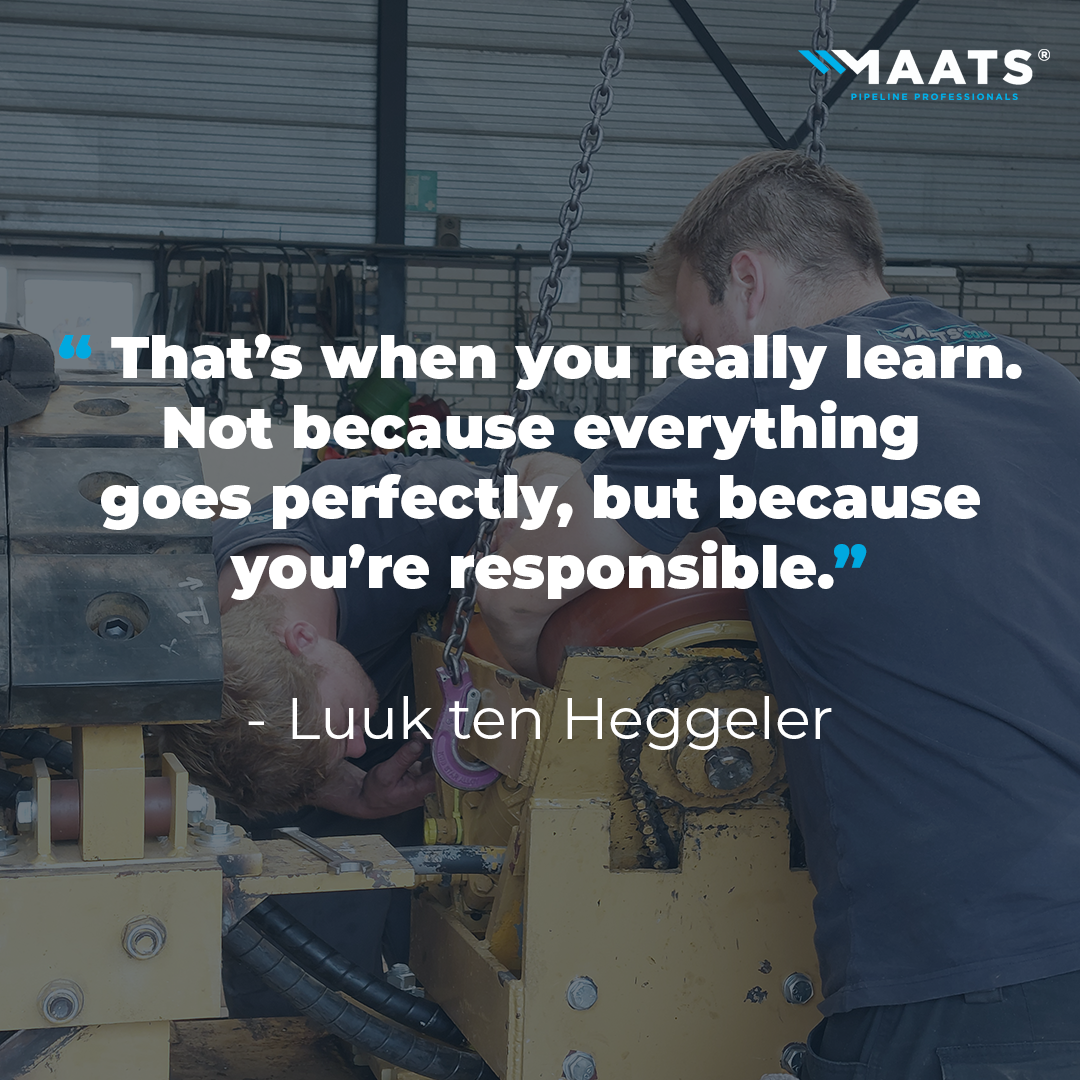
Maats employee Luuk ten Heggeler working on pipeline equipment.

“It grows naturally.”

Gerard has worked with Maats machines since the 1980s. He started as a mechanic and gradually took on more responsibility, not because his job title changed, but because the work demanded it. “It grows naturally,” he says. “You take on what needs to be done.” His role developed alongside the growth of the company and the team, expanding from hands-on work to organising and planning the workshop.

Actively growing into responsibility

Luuk joined Maats in 2022 as a mechanic, but from the start, he was clear that he wanted more than purely hands-on work. Not because he had a fixed role in mind, but because he needs to keep developing. “I need to stay challenged,” he says. “If the work becomes too repetitive, I start getting in my own way.” For Luuk, taking on more responsibility and continuing to learn is what keeps the work enjoyable and motivating.

Where Gerard grew into responsibility almost unconsciously, Luuk actively seeks it out. Besides working in the workshop, he increasingly handles tasks around planning, paperwork, communication with project sites, and decision-making.

At Maats, employees are trusted to grow into responsibility step by step. Rather than following rigid job descriptions, responsibilities develop organically. They are based on initiative, experience, and personal strengths.

Learning through responsibility

International projects are where this trust is put to the ultimate test. Both Gerard and Luuk were trusted to work independently abroad early on. In Luuk’s case, this happened sooner than expected when he was asked to handle his first major project in Morocco on his own.

“That’s when you really learn,” he says. “Not because everything goes perfectly, but because you’re responsible.” At Maats, responsibility is not seen as a risk. Mistakes are discussed and resolved, creating ownership and learning in the process.

Beyond technical skills

Technical skills can be learned through manuals, experience, and logical thinking. What is harder to teach is everything around the work itself: staying calm under pressure, planning ahead, setting priorities, and understanding when something is simply not feasible. Luuk learned this from Gerard and other experienced colleagues. “Saying yes to everything isn’t always right,” he says. “Sometimes no is the better answer.” He refers to situations where planning, safety, or practicality simply do not allow a project to move faster. Promising something unrealistic may satisfy people temporarily, but it ultimately creates bigger problems later on.

For Gerard, these lessons have become second nature over decades of experience. Without consciously teaching them, he passes them on through the way he works, plans, and approaches problems every day.

Experience and perspective

The contrast between Gerard and Luuk strengthens their collaboration. Gerard represents experience built over time, while Luuk brings reflection and new ideas. Where Gerard provides stability, Luuk brings fresh energy and a different perspective. Together, they ensure that knowledge does not remain tied to one person but continues to grow within the team.

A gradual shift

As Gerard approaches retirement, there is no abrupt handover. His role will not be copied one-to-one. Instead, responsibility is gradually shifting to Luuk and another colleague, each shaping their role in their own way. “It doesn’t have to become the same,” Luuk says. “It grows the way it needs to grow.”

What continues to matter

At Maats, knowledge transfer is not limited to formal processes or manuals. It happens every day, through trust and responsibility. By giving people space to make decisions, experience stays within the company, even as roles change.

This is how the workshop remains stable and ready for the future: with craftsmanship as its foundation, trust as its starting point, and people who continue to grow together.

Generations of expertise at Maats Pipeline Professionals

At Maats Pipeline Professionals, we believe long-term quality is built on the right balance between experience and innovation. This balance is clearly reflected in our team, which consists of multiple generations of professionals; from young, ambitious talents to highly experienced specialists who pass on their knowledge every day.

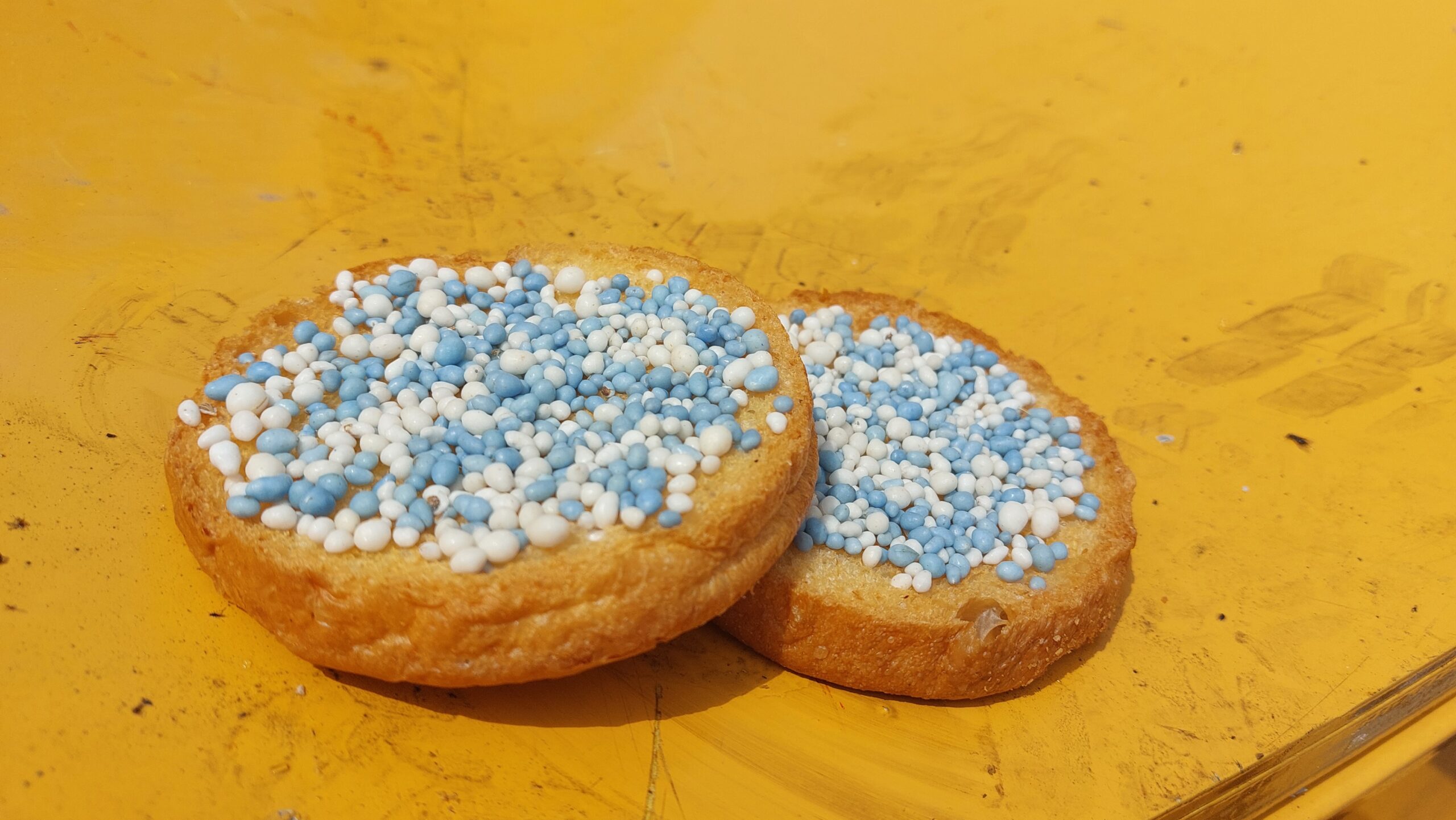
Dutch biscuit with sprinkles as a treat to celebrate a birth

This diversity in age and experience forms the foundation of our organization. Younger colleagues bring fresh perspectives and energy, while seasoned professionals ensure continuity, craftsmanship and mentorship. Knowledge sharing and collaboration are key, enabling us to build a strong team and deliver reliable solutions to our customers worldwide.

The same philosophy applies to our rental fleet. Maats’ equipment ranges from brand-new machines to proven, battle-tested assets that continue to perform reliably on projects across the globe. Just like our people, it’s not about age, but about performance, reliability and suitability for the job.

Beyond expertise and professionalism, Maats values connection and commitment. Over the past year, we welcomed new additions to the Maats family, with employees celebrating the birth of children and even grandchildren. Moments like these highlight that Maats is more than a workplace; it is a company where people grow, both professionally and personally.

By investing in people, knowledge and equipment, we continue to build future-proof partnerships. Generations working together to keep projects moving, today and tomorrow.

Dutch biscuit with sprinkles as a treat to celebrate a new born