“It grows naturally.”
Gerard has worked with Maats machines since the 1980s. He started as a mechanic and gradually took on more responsibility, not because his job title changed, but because the work demanded it. “It grows naturally,” he says. “You take on what needs to be done.” His role developed alongside the growth of the company and the team, expanding from hands-on work to organising and planning the workshop.
Actively growing into responsibility
Luuk joined Maats in 2022 as a mechanic, but from the start, he was clear that he wanted more than purely hands-on work. Not because he had a fixed role in mind, but because he needs to keep developing. “I need to stay challenged,” he says. “If the work becomes too repetitive, I start getting in my own way.” For Luuk, taking on more responsibility and continuing to learn is what keeps the work enjoyable and motivating.
Where Gerard grew into responsibility almost unconsciously, Luuk actively seeks it out. Besides working in the workshop, he increasingly handles tasks around planning, paperwork, communication with project sites, and decision-making.
At Maats, employees are trusted to grow into responsibility step by step. Rather than following rigid job descriptions, responsibilities develop organically. They are based on initiative, experience, and personal strengths.
Learning through responsibility
International projects are where this trust is put to the ultimate test. Both Gerard and Luuk were trusted to work independently abroad early on. In Luuk’s case, this happened sooner than expected when he was asked to handle his first major project in Morocco on his own.
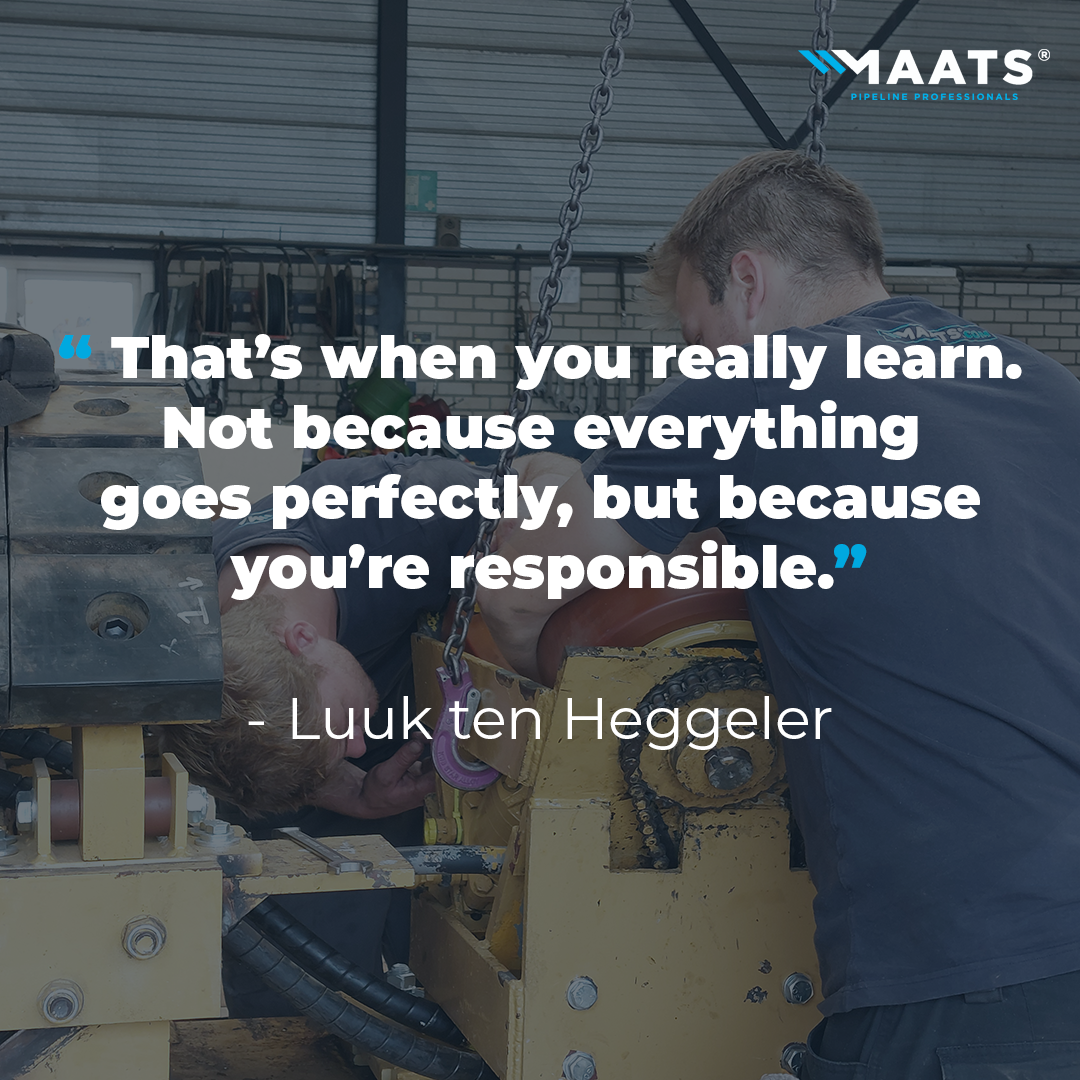
“That’s when you really learn,” he says. “Not because everything goes perfectly, but because you’re responsible.” At Maats, responsibility is not seen as a risk. Mistakes are discussed and resolved, creating ownership and learning in the process.
Beyond technical skills
Technical skills can be learned through manuals, experience, and logical thinking. What is harder to teach is everything around the work itself: staying calm under pressure, planning ahead, setting priorities, and understanding when something is simply not feasible. Luuk learned this from Gerard and other experienced colleagues. “Saying yes to everything isn’t always right,” he says. “Sometimes no is the better answer.” He refers to situations where planning, safety, or practicality simply do not allow a project to move faster. Promising something unrealistic may satisfy people temporarily, but it ultimately creates bigger problems later on.
For Gerard, these lessons have become second nature over decades of experience. Without consciously teaching them, he passes them on through the way he works, plans, and approaches problems every day.
Experience and perspective
The contrast between Gerard and Luuk strengthens their collaboration. Gerard represents experience built over time, while Luuk brings reflection and new ideas. Where Gerard provides stability, Luuk brings fresh energy and a different perspective. Together, they ensure that knowledge does not remain tied to one person but continues to grow within the team.
A gradual shift
As Gerard approaches retirement, there is no abrupt handover. His role will not be copied one-to-one. Instead, responsibility is gradually shifting to Luuk and another colleague, each shaping their role in their own way. “It doesn’t have to become the same,” Luuk says. “It grows the way it needs to grow.”
What continues to matter
At Maats, knowledge transfer is not limited to formal processes or manuals. It happens every day, through trust and responsibility. By giving people space to make decisions, experience stays within the company, even as roles change.
This is how the workshop remains stable and ready for the future: with craftsmanship as its foundation, trust as its starting point, and people who continue to grow together.
