Of course pipe layer manufacturers have to comply with common legislation like the 97/68/EC, 2004/26/EC for engine emissions and they perform their measuring for noise emission according to (for example) ISO 6396:2008 and 2000/14/EC. To some extent, these standards do have a direct relation with the safety and well-being of machine operators, they however focus on specific elements and do not give a general safety guideline for the design of the machinery. For Europe there is the Directive 2006/42/EC that describes the “Essential health and safety requirements relating to the design and construction of machinery”. A more general standard that applies to machinery placed on the market and/or put into service, at least for the EU.
Liebherr and Maats have assessed the basic hazards specific to the operation of a pipe layer. With the initial design, some years ago, Liebherr already chose some distinctive features that result in a safer environment for the operator, with today’s ever stricter regulations it was time to check if any changes or improvements were required. Being the only specific safety related standard available, the Directive 2006/42/EC was chosen as a guideline for the assessment of safety features for pipeline equipment. From this directive there are a number of safety features that can be found mandatory, also for pipe layers and welding tractors.
Risks
The main risk when operating a pipe layer is tipping over as a result of a too heavy or unbalanced load, often in combination with a soft or uneven terrain.
Another risk is faulty operation as a result of the complexity of operation of the machine. The number of handles and buttons need time to get accustomed to but also leave little time to react in case of an emergency.
A third risk is the lack of concentration of the operator resulting in faulty operation of the machine. Operators often are exposed to cold, heat, snow or rain. These factors have a distinct effect on the well-being and concentration of the operator and therefore can have a on the safe operation of the equipment.
Based on the above assessed risks, Liebherr and Maats developed the following solutions:
ROPS structure
There are a number of standards that refer to a ROPS for heavy machinery:
– European Standard EN 474-1:2006, paragraph 5.3.3.1: Roll-Over Protective Structures (ROPS)
“Earth-moving Machinery shall be equipped with a roll-over protective structure (ROPS). The ROPS
shall comply with EN 13510:2000.”
– European Standard EN 474-1:2006, paragraph 5.3.3.2: ROPS for derivative machinery
“For derivative machinery, the ROPS shall be designed taking into account the operating mass (see
ISO 6016:1998) of the derivative machinery in the heaviest configuration as specified by the
manufacturer.”
– European Standard EN 474-9:2006, paragraph 5.2.5: Operator’s protection
“EN 474-1:2006, 5.3.3 does not applied for pipelayers.”
This would mean that a ROPS is not mandatory for pipe layers. The directive 2006/42/EC however states the following:
3.4.3. Roll-over and tip-over
Where, in the case of self-propelled machinery with a ride-on driver, operator(s) or other person(s), there is a
risk of rolling or tipping over, the machinery must be fitted with an appropriate protective structure, unless
this increases the risk.
This structure must be such that in the event of rolling or tipping over it affords the ride-on person(s) an
adequate deflection-limiting volume.
In order to verify that the structure complies with the requirement laid down in the second paragraph, the
manufacturer or his authorised representative must, for each type of structure concerned, perform appropriate
tests or have such tests performed.
Based on this paragraph, a ROPS construction should be in place on a pipe layer. Where, in case of Liebherr, this used to be either a canopy (OROPS) or an enclosed cabin with a ROPS construction, Liebherr now decided to supply all their new pipe layers with enclosed ROPS cabin as a standard. Only the Liebherr welding tractors are still available with OROPS as these machines are less likely to tip over.
Because mounting a cabin might be difficult on older machines, the roll bar is an option as an aftermarket product, on new machines however the enclosed cabin is the absolute safest solution, adding relatively little to the price of a new pipe layer.
In order to comply with the above paragraph 3.4.3., Liebherr chose the ISO 3471 “Earth-moving machinery – Roll-over protective structures – Laboratory test and performance requirements (ISO 3471:2008, IDT)” as the standard to comply with.
Boom with hydraulic cylinder
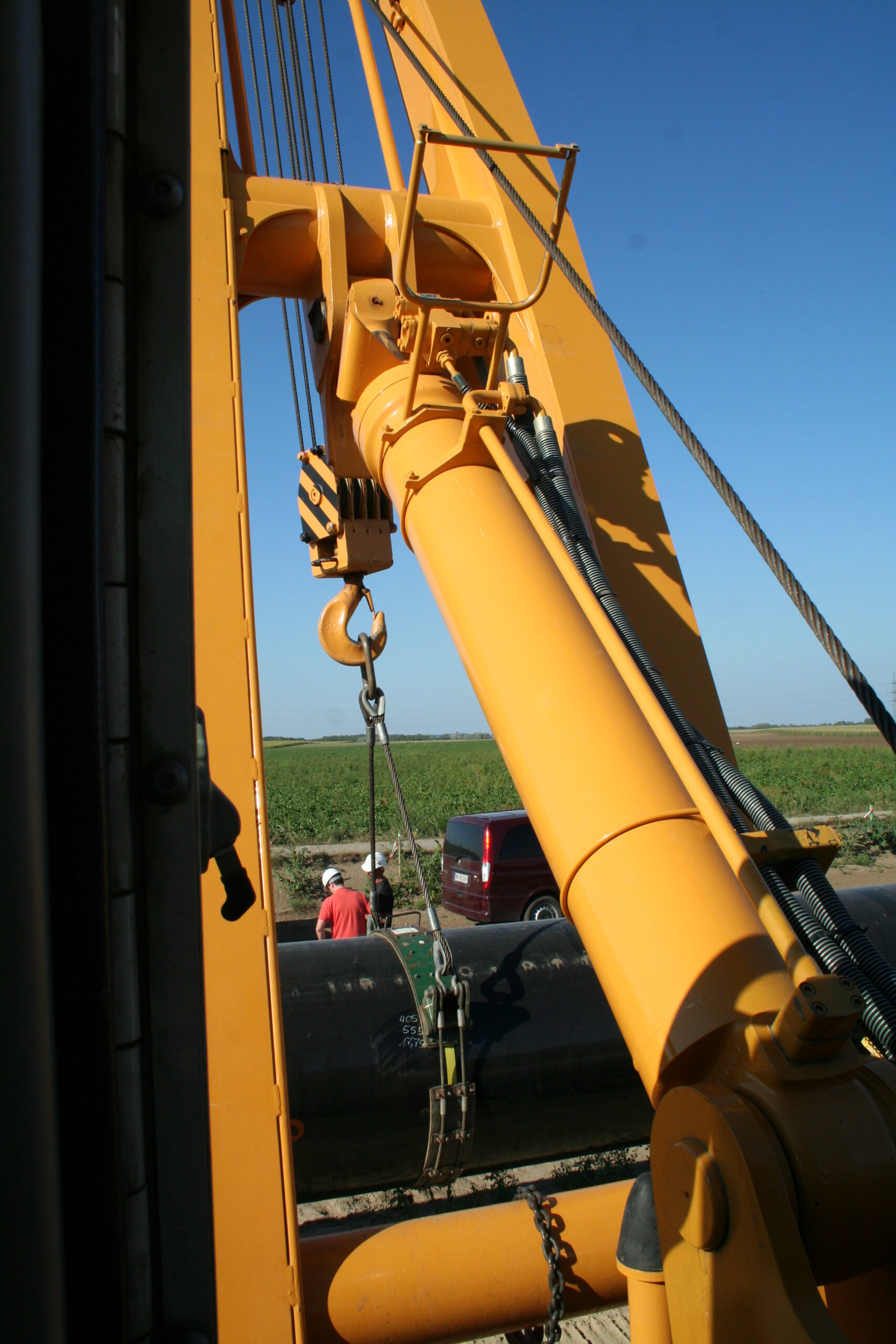
In addition to the ROPS, Liebherr decided to use a hydraulic cylinder instead of a winch for operation of the boom. Besides to the fact that this cylinder provides a very accurate operation of the boom, especially useful when the machine is used with a bending machine or a welding crew, this boom is designed to hold the weight of the machine in case the machine tips over towards the load side. An additional advantage is the elimination of the risk of an overpull of the boom with the boom winch.
Safe Load Indicator (SLI)
More and more principals around Europe are asking for a safe load indicator on pipe layers. Although the pipe layer is not a crane as such, principals see the SLI as an aid to prevent accidents with machines as a result of too heavy loads. Reference is made to the Directive 2006/42/EC that states:
4.2.2. Loading control
Machinery with a maximum working load of not less than 1 000 kilograms or an overturning moment of not
less than 40 000 Nm must be fitted with devices to warn the driver and prevent dangerous movements in the
event:
– of overloading, either as a result of the maximum working load or the maximum working moment due to
the load being exceeded, or
– of the overturning moment being exceeded.
To help the operator to determine the actual loading of the machine and to avoid tipping over in the first place, Liebherr and Maats developed a Safe Load Indicator (SLI). The SLI informs the pipe layer operator continuously about the loading of the machine, regardless of the position of the equipment. In case the machine reaches its maximum load limit, the SLI will recognize this and, depending on the setting of the SLI, will either give a signal or additionally limit the functionality of the machine.
The operator has the possibility to switch between three different settings, the SLI switched off, the SLI operating as a load indicator only and finally the SLI operating as load indicator with automatic load limiter.
When the machine is loaded within a certain range of its maximum capacity (acc. to ISO 8813), the operator is informed accordingly. This system has both a visual and an acoustic signal inside the cabin. A visual and acoustic signal on the outside of the cabin is optional.
Fully enclosed cabin
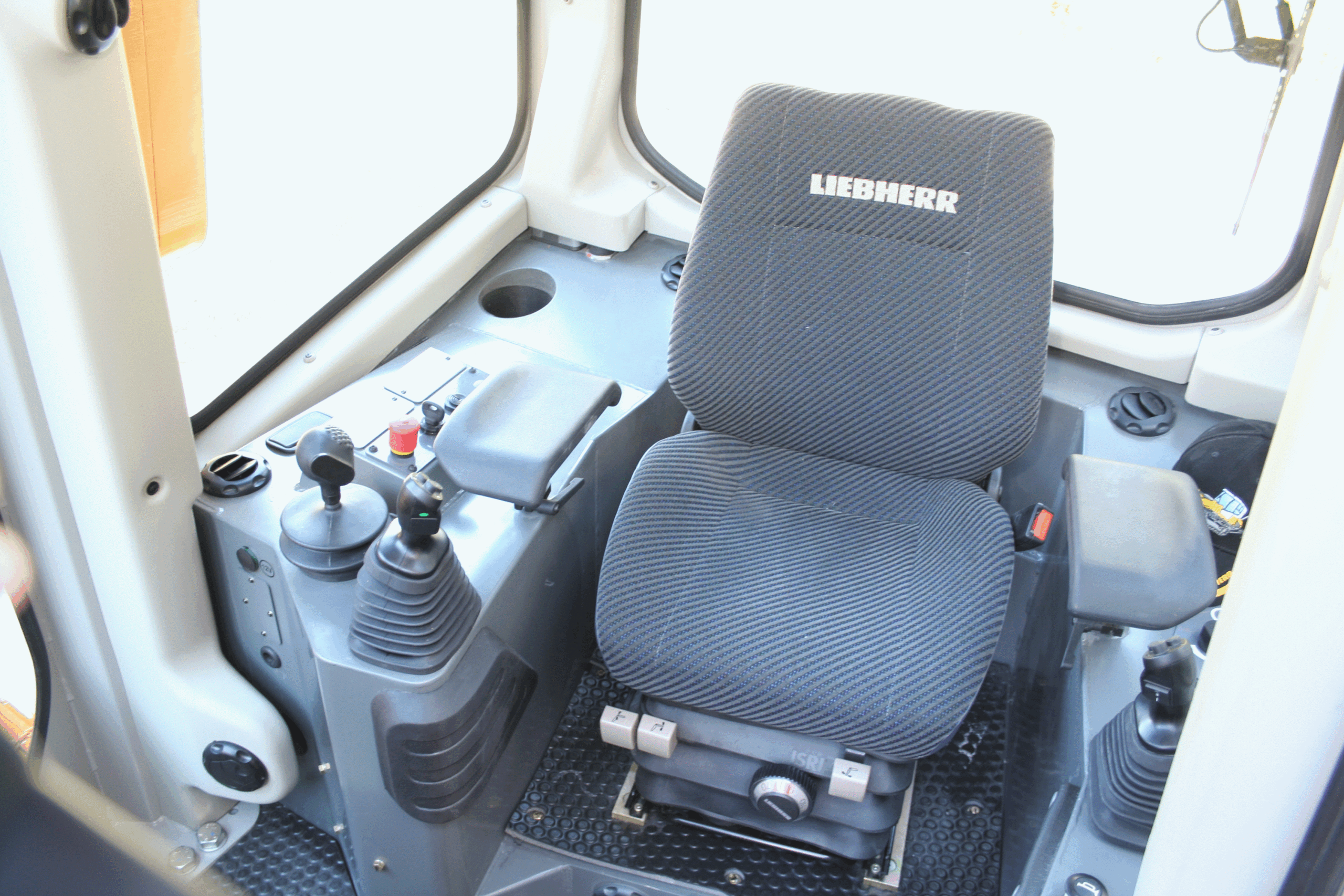
A further reason to choose a fully enclosed cabin (apart from the ROPS) is the possibility to create a comfortable environment for the operator. Cabins are provided with a heater as standard and with air conditioning as an option. Furthermore all cabins are equipped with positive pressure ventilation, this to keep dust outside the cabin. All this keeps the operator comfortable and helps him concentrate on the job at hand. To further add to the well-being of the operator, Liebherr has turned the operators’ seat 15° towards the load side, this means that operators have a better view on the job at hand with less stress on neck, shoulders and higher back.
Single joystick operation
All basic functions can be controlled with two joysticks, one that controls the travel of the machine and one that controls both the boom and the hook. Liebherr was the first to use joysticks for pipe layer and welding tractor operation. These provide an intuitive way of operating the machine easy and precise. Releasing the travel joystick will result in immediate cut off of power to the tracks. As the hydrostatic drive of the Liebherr machine does not need mechanical brakes, there is no necessity to operate them in case of emergency!
Hydrostatic drive
The hydrostatic drive line has a long tradition in the history of the Liebherr company. As the only manufacturer Liebherr offers this modern drive concept also on pipe layers. The self lock of this system eliminates the need of a service brake, which could wear down. Moreover, a hydrostatic drive line does not need special mountain brakes, often used when machines have to operate on steep slopes. An emergency button on the dashboard cuts of power to the tracks completely, the operation hydraulics (boom, hook and counterweight) stops automatically when the operator releases the joystick.
Another advantage of the hydrostatic drive is the lack of gears, there is a constant smooth build-up of power and speed, making it much easier for an operator to stay in control of the load.
Free fall device
Of course the hydraulic winch that operates the hook is fitted with a free fall device. This is operated by a single push of a button on the joystick that operates the hook.
Conclusion is that this assessment of risks has resulted in additional safety measures, not for Liebherr but for Maats. Although Maats has mainly Liebherr machines in their rental fleet, with all safety features as described above, it has been decided that the remaining non-Liebherr pipe layers in the rental fleet will be equipped with ROPS. This ROPS should be suitable for tests according to the EN 13510:2000 and ISO 3471:2006. Complying with these standards means also that Maats can supply the ROPS structure with a CE certificate.